
Armenia and the US: Time for New Thinking  By Eduard Abrahamyan, Senior Fellow with the London-based Institute for Statecraft
Armenia’s 2018 Velvet Revolution raised hopes for a reinvigoration of the country’s decades-long partnership with the U.S. However, this relationship remains stagnant, despite the visit of a U.S. delegation led by National Security Advisor John Bolton in October 2018 and the subsequent visit of Deputy Assistant Secretary George Kent to Yerevan in May 2019, resulting in the formal elevation of Armenia’s relations with the U.S. to the level of “strategic dialogue.” Moreover, Yerevan’s decision to dispatch a military-humanitarian mission to Syria remains an irritant in its interaction with Washington.
READ MORE
- EGF Editor |
Published on EGF: 07.10.2019
| External Relations
-
China's Underestimated Strategic Engagement in Central Asia  By Armine Arzumanyan, Graduate of Renmin University, PR of China
China's main goals in Central Asia may not directly hint at the region's long-term strategic importance, but the outcomes of China's engagement in the region clearly show concrete signs of it. China's emergence as the dominant actor in the region’s energy and infrastructure sectors, along with its growing presence as the lender of choice for Central Asia, has had deep consequences as Beijing has quietly cultivated the defense component of its newfound presence in region. Though relatively little studied, China's energy-infrastructure-defense tridimensional approach is of immense importance. READ MORE.
- EGF Editor |
Published on EGF: 02.10.2019
| External Relations
-
Armenia–China: Strategic Partnership for Mutual Benefits  By Benyamin Poghosyan, PhD, Executive Director, Political Science Association of Armenia
Armenia and China are both among the ancient civilizations of human history. They share millennia of mutual contacts via the ancient Silk Road. However, history is not the only thing which unites the two nations. Both Armenians and Chinese put enormous emphasis on protecting their national identities and traditions. Of course, this does not mean that Armenia and China are not interested or involved in the current wave of globalization. READ MORE
- EGF Editor |
Published on EGF: 24.09.2019
| External Relations
-
Armenia-Azerbaijan: Searching for New Models of Dialogue  Joint Study with “Yeni nesil”, coordinated by Boris Navasardian, President, Yerevan Press Club
The main purpose of this study was to consider the feasibility and prospects of revival of the Track-2 diplomacy and the development of appropriate recommendations. Although it was conceived and supported by the US government even before the political changes in Armenia, its relevance was confirmed by the intensification of the dialogue at the official level between Yerevan and Baku in the summer of 2018. Certain characteristics of the renewed interest in the informal communication were revealed during the visit to Yerevan of the Azerbaijani journalist Shahin Hajiyev, in February 2019, and by the interest of Armenian journalists to visit the neighboring country. READ MORE
- EGF Editor |
Published on EGF: 16.09.2019
| External Relations
-
How Will Uzbekistan Become A Regional Transit Hub?  By Fuad Shahbazov, Baku-based independent regional security and defence analyst
On 5th April of 2019, a meeting of the railway authorities of Kazakhstan, China, Iran, Turkmenistan, and Uzbekistan took place in Almaty dedicated to advancing cargo traffic along the North-South Transit Corridor. In fact, the participation of Uzbekistan in the project will shorten the route of goods from China to Iran and forward. Being a part of the ambitious North-South Transit Corridor, the China-Kazakhstan-Turkmenistan-Uzbekistan-Iran railway can shape the geopolitics of Central Asia. READ MORE
- EGF Editor |
Published on EGF: 14.05.2019
| External Relations
-
New Caspian–Black Sea Transit Corridor Boosts Geostrategic Importance of South Caucasus By Fuad Shahbazov, Baku-based independent regional security and defence analyst
On March 4, Romania, Azerbaijan, Georgia and Turkmenistan held a ministerial meeting in Bucharest—the first such quadripartite gathering for these governments. During this meeting of their foreign ministers, the parties issued a joint statement reaffirming mutual respect for each other’s sovereignty, territorial integrity and inviolability of their internationally recognized borders. Additionally, a number of other important issues were raised in Bucharest, including a discussion on establishing a multimodal corridor for the transport of goods between the Black Sea and Caspian Sea basins, a project officially named the Caspian Sea–Black Sea International Transport Corridor (ITC-CSBS). READ MORE
- EGF Editor |
Published on EGF: 09.04.2019
| External Relations
-
Armenia's "Other Choices"? By Benyamin Poghosyan, PhD, Executive Director, Political Science Association of Armenia
It is time for Armenia to deepen its relations with Iran and China, out of necessity rather than choice.
Armenia continues to face a hard geopolitical reality. The 2018 Velvet revolution has brought hope of the possibility of significant and systemic changes in domestic policy - including in the fight against corruption, furthering the rule of law, and reducing monopolies over key imports and exports from and to Armenia. However, the revolution did not change the geopolitical juncture around Armenia. Yerevan continues to face joint Azerbaijani-Turkish pressure to make concessions in the Karabakh conflict settlement process. READ MORE
- EGF Editor |
Published on EGF: 01.04.2019
| External Relations
-
Eurasia After the Rise of China: The Role of Armenia  By Armine Arzumanyan, Student, Renmin University, PR of China
Aiming to create a future where all roads lead to Beijing, China now plans to obtain a global role in politics by putting itself at the centre of global economic affairs through the Belt and Road Initiative (BRI), which is the most ambitious geo-economic vision in recent history. The BRI and its goals, that have been given many different evaluations, has suggested cooperation in Central Asia, West Asia and Eastern Europe. To maintain a balanced security environment at the conjunction of Europe and Asia and to ensure a successful realization of the BRI, China will need a reliable strategic partner in the South Caucasus. This essay points out why Armenia is most likely to be the strategic ally China will need, drawing out the main perspectives and paradigms for more advanced Sino-Armenian relations. READ MORE
- EGF Editor |
Published on EGF: 20.03.2019
| External Relations
-
A Paradigm Based upon the Madrid Principles Is Not Acceptable for either Armenia or Karabakh By Benyamin Poghosyan, PhD, Executive Director, Political Science Association of Armenia
Since the victory of the "Velvet Revolution" in Armenia, the key foreign policy issue facing the new Armenian authorities is the Karabakh conflict. The negotiation process has been stalled since the failed Kazan summit in June 2011, and the April 2016 four day war made any possible movement forward even less likely. The negotiations after April 2016 were focused on the launch of confidence building measures including the establishment of the ceasefire violations investigation mechanisms and the increase of the OSCE monitoring mission personnel. However, even these modest goals were difficult to achieve as Azerbaijan was urging for a start of "substantial" negotiations on issues of territories and status, otherwise perceiving the confidence building measures as a way to cement the current status quo. READ MORE
- EGF Editor |
Published on EGF: 19.03.2019
| External Relations
-
Kazakhstan’s Successful Two-Years Membership in the United Nations Security Council 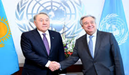 By the European Geopolitical Forum Editorial Staff
In 2018, the Republic of Kazakhstan successfully completed its two-year membership of the United Nations Security Council (UNSC). Over this period, Astana acted as an honest broker, known for its effective balanced approach and neutrality against all international actors.
In just two years, representatives of Kazakhstan took part in more than 1,000 open and closed UNSC meetings, 38 informal events, and contributed to 115 resolutions and 48 statements of the Council Presidency. READ MORE. See the original on-line media publication here
- EGF Editor |
Published on EGF: 06.03.2019
| External Relations
-




