Ukraine’s OSCE Chairmanship and the Transnistrian Conflict: A Breakthrough in the Making?  Paul Pryce
EGF Affiliated Expert on Conflict Management and the OSCE Institutions
Since the outbreak of initial hostilities in November 1990, the Transnistrian conflict persists. While numerous initiatives have been proposed over the past two decades both by external actors and by the parties to the conflict, the de jure Moldovan government and the de facto Transnistrian authorities, little progress has been made to secure a more lasting peace.
Click here to read more.
- Paul Pryce |
Published on EGF: 17.10.2012
| Security
-
The evolution of European and Euro-Atlantic policy making in the wider Black sea: EU and NATO attempts at strenghening regionalism in an area of strategic interest 
(232 Kb)
Introduction
Debates about the geopolitical, geo-economic and strategic significance of the wider-Black Sea (WBS)
region have become fashionable amongst Western policy makers and the international scholarly
community since the end of the Cold War. While the Black Sea represented a “front line” in the stand-off
between rival superpower blocks during an age which now seems to have slipped into the bygone days of
our youth, the major geopolitical realignments which have taken place in Eurasia during the last two
decades have evidently led to our “re-discovery” of one of the world’s most historically significant
geostrategic playing fields. READ MORE
- Marat Terterov and George Niculescu |
Published on EGF: 31.07.2012
| External Relations
-
The unresolved conflicts in the South Caucasus: Implications for European and Eurasian integration (96 Kb)
BSIS, University of Kent, Brussels, 8 December 2011 Provisional summary of seminar findings
By Dr Marat Terterov and Mr. George Vlad Niculescu, European Geopolitical Forum, Brussels
On December 8 2011, The European Geopolitical Forum staged a seminar on the topic “The Unresolved Conflicts in the South Caucasus: Implications for European and Eurasian Integration” at the University of Kent/Brussels School of International Studies. The seminar represented a concerted attempt by the organizers to provide a platform for a lively and objective roundtable debate where experts of different orientations would have the opportunity to engage in a frank exchange of positions on the highly sensitive subject matter of South Caucasus unresolved conflicts. In contrast to many events taking place in Brussels, the organizers of the December 8 seminar did not have the objective of taking sides in political disputes, or seeking to promote the merits of one side at the expense of the other. READ MORE
- EGF Editorial |
Published on EGF: 17.02.2012
| External Relations
-
Key points of the EGF Director Dr. Marat Terterov’s interview to the Caucasus Journalists Network on January 23rd 2012 (121 Kb)
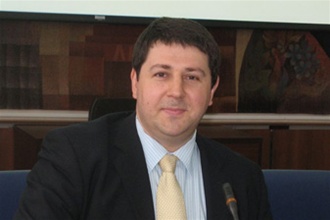
Karabakh conflict
Angela Khachatryan, the Zhamanak (Time), www.1in.am portal (Armenia)
- Mr. Terterov, what effect can the crisis in Europe
have on the countries of association partners to the
EU, of which Armenia is one?
MT: I think the main point to take here is the question
of whether countries in the EU’s Eastern Partnership
framework, or those coming into the wider-European
Neighbourhood context, are a priority for EU external
relations strategies. Clearly, some countries come
higher up the EU pegging order than others. This also
depends on which EU member states holds important
positions in the EU institutions, including the
rotational presidency of the Council of the European
Union, and the foreign policy strategies which those
countries entertain. Clearly, when France holds the
presidency, one can assume that greater EU external
policy resources will be directed towards the South
Bank Mediterranean countries. This is also likely to be
the case even more so now with the EU having to
show its “interest” in the region in way of
developments associated with the Arab Spring. When
Poland, for example, holds the presidency, it is likely
greater EU foreign policy resources will be directed
towards Ukraine and Belarus. READ MORE
- EGF Editorial |
Published on EGF: 05.02.2012
| External Relations
-
The Changing Dynamics of the Wider-Black Sea in Regional Security and External Relations (816 Kb)
Executive Summary
On Monday, May 16, 2011, The European Geopolitical Forum staged a roundtable discussion on the
“Changing Dynamics of the Wider Black Sea in Regional Security and External Relations” at the Brussels
School of International Studies, University of Kent. The roundtable featured key international speakers: Dr.
Andrej Kreutz (Canada), renowned international relations specialist and author of the recent book, “Russia
in the Middle East: Friend or Foe?”; and Igor Muradyan (Armenia), an acclaimed public commentator on
the geopolitics and geo-economics of the Black Sea-Caucasus-Caspian area. The roundtable discussion also
drew participation of officials from the Turkish Embassy in Belgium, NATO International Staff Political
Affairs and Security Policy Division (IS PASP), the Mission of Ukraine to European Union, the Permanent
Mission of the Russian Federation to NATO, the Energy Charter Secretariat, TUSIAD, the Armenian
Federation of Europe, the Centre for East European and Asian Studies (Romania) and several other
interested stakeholders. READ MORE
- EGF Editorial |
Published on EGF: 13.11.2011
| Security
-
As Eastern Mediterranean’s Waters Heat Up, Turkey Should Lead An OSCE-Type Initiative In The Middle East (125 Kb)
 by Mehmet
Ogutcu,
by Mehmet
Ogutcu,
Expert in global energy security matters
The Turkish leadership has committed itself to a tough position on Israel, Cyprus and Syria, and any backtracking or sign of weakness will seriously affect its credibility at home, with regional partners, the “Arab Street” and other major global powers, as well as high stakes involved in the Eastern Mediterranean. This represents a policy of principle, consistent with the values and goals the government pursues, but is also a risky one, which if not well managed may lead to some undesirable hot confrontation. The power comes with responsibility if it will be effectively harnessed.
- EGF Editorial |
Published on EGF: 05.10.2011
| Security
-
Five good reasons to be sceptical about the ‘Arab Spring’  by Marat Terterov,
EGF Director
When a game breaking event takes place in the Middle East once each decade
There is a certain understanding amongst Middle East politics experts that a game breaking event of cataclysmic proportions hits the region once every ten years or so. September of this year will mark the 10th anniversary of the unimaginable acts of terrorism which were perpetrated in New York in September 2001 by Arab suicide bombers. These acts of violence catapulted America’s ‘War on Terror’ to the centre of Washington’s foreign policy agenda, opening the way for renewed civil war in Afghanistan and the US-led invasion of Iraq of 2003. READ MORE
- Marat Terterov |
Published on EGF: 15.09.2011
| Security
-
Erdogan’s legacy for Turkey in his final term Turkey's 17th general election was never an election about who would win; it was a foregone conclusion that the Justice and Development Party (AK Party) would do that and that Recep Tayyip Erdogan, in his final term as the prime minister, would be given not only the mandate to govern but also the moral authority to forge Turkey’s future in the next four years and, arguably, beyond. READ MORE
- By Mehmet Ogutcu, Formely Turkish Diplomat, Head of OECD Global Forum and currently Multinational Executive and Sir David Logan, Former UK Ambassador to Turkey and Chairman of British Institute in Ankara |
Published on EGF: 21.07.2011
| Security
-