
TRIPP/Zangezur Corridor Must Serve both Peace and Connectivity
 By Vasif HUSEYNOV, PhD, Head of Department, AIR Center, Adjunct Lecturer, ADA and Khazar Universities, Baku
The Zangezur Corridor – recently rebranded as the Trump Route for International Peace and Prosperity (TRIPP) — has become one of the most discussed and debated infrastructure projects in Eurasia. Stretching 43 kilometres through Armenia’s Syunik Province, it promises to reconnect mainland Azerbaijan with its Nakhichevan exclave and, through Türkiye, to Europe. It is a project of logistics and trade — a corridor capable of shortening cargo transit from Asia to Europe from 18 days to 12 along the Middle Corridor, reducing dependency on maritime choke points, and creating new opportunities for growth across the South Caucasus. In practice, however, the TRIPP risks becoming a stage for geopolitical contestation unless regional actors ensure that its purpose remains economic, inclusive, and depoliticized. READ MORE
- EGF Editor |
Published on EGF: 13.11.2025
| Security
-
Russia’s Exclusion from Joint Caspian Drills Shows Regional Shift
 By Fuad SHAHBAZOV, Baku-based independent regional security and defence analyst
On October 25, Azerbaijan participated in the Nusret-2025 Invitation Exercise, a joint military drill held in the Gulf of Soros in Türkiye. The exercise aimed to strengthen cooperation between the Turkish Naval Forces and the naval forces of friendly and allied countries, such as Azerbaijan. This is the latest example of Azerbaijan’s partnership with Türkiye in strengthening its naval forces. The Caucasus region, particularly the Caspian littoral, is emerging as a focal point of geopolitical competition amid rising tensions between Russia and the West. The Caspian, often referred to as a “Russian lake” during the Soviet era, has presented new challenges to Russia’s regional dominance since 2022. Until the 2020s, Russia remained the most powerful naval power in the Caspian Sea, despite Kazakhstan, Azerbaijan, and Iran systematically enhancing their naval capabilities over the past three decades. Russia’s full-scale invasion of Ukraine in 2022, as well as regional conflicts and reordering, have exacerbated Moscow’s declining leverage and hegemony in the South Caucasus and Central Asia. READ MORE
- EGF Editor |
Published on EGF: 07.11.2025
| Security
-
Kazakhstan Aims to Modernize Military Through Multi-Vector Diplomacy
By Fuad Shahbazov, Baku-based independent regional security and defence analyst
Kazakhstan has recently been making steps to improve its defence capabilities. In April 2025, the Kazakh Ministry of Defence confirmed that a legislative framework was established to regulate the Defence Industry Development Fund, which was created in December 2023. The new defence fund aims to acquire and manufacture domestically crucial military hardware, such as artillery ammunition, weapons systems, and combat modules. For this purpose, the Kazakh government plans to allocate approximately $265 million from the state budget. Earlier, on March 3, Kazakh Defence Minister Ruslan Zhaksylykov announced the establishment of a new defence industry centre at the only tank repair plant in Central Asia in the Eastern city of Semey. Zhaksylykov proclaimed that the new hub aims to strengthen “Kazakhstan’s self-sufficiency in defence production” through “expanding the ability to both maintain and manufacture crucial military technologies locally”. As the regional order in Eurasia shifts amid Russia’s war against Ukraine, Kazakhstan is opting to rely on its armed forces, domestic military resources, and international security partnership formats to counter any potential threat. READ MORE
- EGF Editor |
Published on EGF: 09.07.2025
| Security
-
Uzbekistan: Development of Culture – A Key Tool for Preserving National Identity 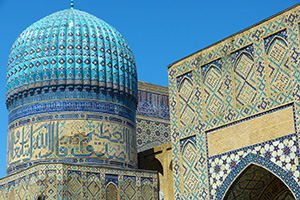 Ozodbek Nazarbekov, Minister of Culture of the Republic of Uzbekistan
Culture and art are the foundation of civilization, national identity, and spiritual perfection, as well as important indicators of a country’s progress. The development of these spheres, reflecting the spiritual growth of the people, their past, present, and future, requires an approach that meets the demands of the times. This is why the reforms aimed at the development of culture and art in Uzbekistan carry profound meaning and are entering a new phase.
READ MORE
- EGF Editor |
Published on EGF: 20.12.2024
| Security
-
In Uzbekistan, strengthening interethnic and interfaith solidarity is always a priority of state policy  Samariddin Sattorov,
Chief Researcher of the Institute for Strategic and Regional Studies under the President of the Republic of Uzbekistan
In recent years, geopolitical tensions have been increasing in different regions of the world, and interethnic conflicts and contradictions on religious grounds continue to worsen.
In the context of such instability, maintaining an open and constructive dialogue between different religious and cultural groups is becoming vital. Strengthening religious tolerance helps to create an atmosphere of mutual understanding, respect and generosity in society, which in turn alleviates tensions and prevents the escalation of conflicts. READ MORE
- EGF Editor |
Published on EGF: 06.12.2024
| Security
-
Strengthening the rights of citizens in the area of freedom of receiving and disseminating information in the new Uzbekistan
Karine Javakova,
Head of the Department of State and Legal Disciplines and Ensuring Human Rights of the Academy of the Ministry of Internal Affairs of the Republic of Uzbekistan, Doctor of Philosophy, Professor
Uzbekistan has created a solid legal framework to ensure freedom of speech and information, as well as the development of the media, improvement of the legal basis for the activities and protection of the professional rights of journalists. Considering that the liberalization of the information sphere and its development are priority tasks in the construction of the New Uzbekistan, after the constitutional reform, the articles devoted to these rights were significantly expanded. READ MORE
- EGF Editor |
Published on EGF: 14.10.2024
| Security
-
New Uzbekistan: human rights and parliamentary elections
A.Kh. Saidov,
First Deputy Speaker of the Legislative Chamber of the Oliy Majlis of the Republic of Uzbekistan, Director of the National Center of the Republic of Uzbekistan for Human Rights
The modern economic and democratic systems are designed to uphold the rights and freedoms of every individual. As is widely acknowledged, there is no universal model for democratic development; it must evolve based on each country's unique conditions and the needs of its people, avoiding rigid formulas. READ MORE
- EGF Editor |
Published on EGF: 08.10.2024
| Security
-
New powers of the parliament of the New Uzbekistan Akilov Alimjon Rakhimovich,
Chief Researcher of Department of analyzing the effectiveness of constitutional construction and public administration of Institute of Legislation and Legal Policy under the President of the Republic of Uzbekistan, doctor of legal sciences, professor
The year 2016 for Uzbekistan was marked by the beginning of a fundamentally new in essence and content stage of state and social construction, in which the main strategic goal was proclaimed - the construction of a New Uzbekistan, based on the values that served the greatest flourishing of our statehood in the 9th-10th centuries (known in world history as First Eastern Renaissance) and XIV-XV centuries (Second Eastern Renaissance). As in previous periods, the basis and priorities of the Third Renaissance of our statehood are the development of science and modern technologies, which are intended to become drivers of dramatic development of the country’s economy, a radical improvement in the well-being of the people and the prosperity of the nation. READ MORE
- EGF Editor |
Published on EGF: 30.08.2024
| Security
-
Uzbekistan’s renewed electoral system a key factor in the advancement of representative democracy Shuhrat Bafayev,
Chairman of the Committee for Democratic Institutions, Nongovernmental Organizations and Citizens’ Self-Government Bodies, Legislative Chamber of the Oliy Majlis of the Republic of Uzbekistan
Over the years of independent development Uzbekistan firmly guided by the principles of universal, equal and direct suffrage in secret voting, has progressively implemented international electoral standards into its electoral legislation. In 2017, in his first Address to the Parliament, the President of Uzbekistan Shavkat Mirziyoyev suggested that the current national electoral legislation does not ensure its harmonization and proposed to develop an Electoral Code that meets international norms and standards. Thus, the Electoral Code was adopted in 2019, incorporating more than 30 new democratic norms for organizing and conducting election processes. The approval of the Code marked the dawn of a new stage in the development of representative democracy in the country. READ MORE
- EGF Editor |
Published on EGF: 26.08.2024
| Security
-




