
Armenia Should Avoid Replacing Foreign Policy Diversification with an Anti-Russian Strategy  By Benyamin POGHOSYAN, PhD, Chairman, Center for Political and Economic Strategic Studies By Benyamin POGHOSYAN, PhD, Chairman, Center for Political and Economic Strategic Studies
Since the 2020 Nagorno Karabakh war, diversification has probably been the most-used term in discussions about the future of Armenian foreign policy. It should be noted that Armenia has sought to pursue a diversified foreign policy since the early years of independence. In parallel with establishing a strategic alliance with Russia, Armenia has launched a pragmatic partnership with the EU and NATO. Armenia signed its first IPAP (Individual Partnership Action Plan) with NATO in 2005. NATO was actively involved in the defence reforms in Armenia accelerated after 2008, including defence education and strategic defence review. Armenia joined the EU Eastern partnership initiative in 2009. It failed to conclude the Association Agreement with Deep and Comprehensive Free Trade Area. Instead, it signed the Comprehensive and Enhanced Partnership Agreement in 2017, now serving as the solid base for Armenia–EU relations.
READ MORE
- EGF Editor |
Published on EGF: 26.10.2023
| External Relations
-
What Next for Nagorno Karabakh? By Benyamin POGHOSYAN, PhD, Chairman, Center for Political and Economic Strategic Studies
On September 19, 2023, Azerbaijan launched a military offensive against the self-declared Nagorno Karabakh Republic with one clear goal – to destroy it. It was a logical continuation of Azerbaijan’s decades-long policy, including the 2020 Nagorno Karabakh war and the blockade of the Lachin (Berdzor) corridor imposed in December 2022. After 24 hours of intensive fighting, the self-declared Nagorno Karabakh Republic surrendered. A few days later, the large exodus of the Armenian population started, and by the end of September 2023, less than 100 Armenians were left in Nagorno Karabakh. On September 28, the president of the self-declared Nagorno Karabakh Republic signed a decree to dissolve the Republic by the end of 2023.
The reaction in Armenia to these events was somewhat surprising. The government made it clear that Armenia would not intervene to prevent the destruction of Nagorno Karabakh. Most Armenians went to social media, lamenting the lack of actions by Russia, the EU, and the US. Many were genuinely surprised that for Russia and the collective West, geopolitical or economic interests had more value than the fate of 100,000 Armenians who lived in Nagorno Karabakh for the last several millennia.
READ MORE
- EGF Editor |
Published on EGF: 19.10.2023
| External Relations
-
How will the destruction of NKR impact the Armenia-Azerbaijan peace process? By Benyamin POGHOSYAN, PhD, Chairman, Center for Political and Economic Strategic Studies
Azerbaijan's destruction by force of the self-declared Nagorno Karabakh Republic (NKR) is seen by some as removing one of the key obstacles in the negotiations between Armenia and Azerbaijan, that will resume in the next days in Granada, Spain. Others however see the elimination of the Karabakh factor as opening the way for Azerbaijan to make even more demands on Armenia. It is challenging to assess whether peace between Armenia and Azerbaijan is within reach. However, one thing is clear: the second humiliation of Armenia within three years has already triggered significant backlash among Armenians. Many are still in shock, which is why Yerevan witnessed only small protests recently. However, many Armenians are fed up with permanent losses, and there is a growing feeling that Armenia, in the long–term perspective, should become stronger to reclaim its position in the region. In the current environment, any attack of Azerbaijan against Armenia, regardless of pretexts or reasons, will only strengthen this feeling among Armenians and will be a direct path to long-term instability and conflicts in the South Caucasus.
READ MORE
- EGF Editor |
Published on EGF: 04.10.2023
| External Relations
-
Turkey Supports Azerbaijan’s Operation in Karabakh
 By Fuad SHAHBAZOV, Baku-based independent regional security and defence analyst By Fuad SHAHBAZOV, Baku-based independent regional security and defence analyst
On September 19, Azerbaijan launched an “anti-terrorist operation” in the Karabakh region against armed separatist forces. The operation followed three years of largely unproductive peace talks between Armenian and Azerbaijan following the Second Karabakh War in 2020. The clashes ended in a ceasefire after only one day due to the separatist regime’s limited military-technical capacity in resisting the well-equipped Azerbaijani Armed Forces.
Baku’s allies were quick to applaud the move. For example, Turkish President Recep Tayyip Erdogan, during a joint news conference with Azerbaijani President Ilham Aliyev, declared, “It is a matter of pride that the operation was successfully completed in a short period of time, with utmost sensitivity to the rights of civilians”. Turkey has traditionally been a staunch ally of Azerbaijan, and the recent military operation to reclaim Karabakh plays into Ankara’s regional interests, especially regarding the future development and opening of the Zangezur Corridor.
READ MORE
- EGF Editor |
Published on EGF: 04.10.2023
| External Relations
-
Iran Policy in the Context of Armenia – Azerbaijan Peace Negotiations By Benyamin POGHOSYAN, PhD, Chairman, Center for Political and Economic Strategic Studies
As Armenia and Azerbaijan come closer to signing an agreement by the end of 2023, and competition grows between Russia and the West to lead the process and take the prize of the main pacifier, other regional actors take steps to clarify their positions. In this context, Iran stands out as one of the primary buffers against the growing role of the West in the South Caucasus.
Being engaged with the US in continuing negotiations to revive the 2015 nuclear deal in full or at least partly, Iran is simultaneously concerned by the US efforts to reduce Russian influence in the South Caucasus. This is not because Iran loves or trusts Russia but because Iran understands the dangers of being encircled by the US, including from the north. Moreover, for Iran, US influence does not mean US military bases or US direct investments.
READ MORE
- EGF Editor |
Published on EGF: 04.08.2023
| External Relations
-
Russia Determined Not to Be Marginalised in the Armenia-Azerbaijan Negotiations By Benyamin POGHOSYAN, PhD, Chairman, Center for Political and Economic Strategic Studies
Russian demands to include in the peace agreement the issue of rights and security of the Armenians of Nagorno-Karabakh may allow Armenia to take a more flexible position during the upcoming negotiations and seek to create minimally acceptable conditions for Armenians living in Nagorno Karabakh.
In recent months it appeared that the US and the EU had taken the lead in pushing forward Armenia – Azerbaijan negotiations. In May and June, the US organized two meetings of the foreign ministers with their respective teams to work on the text of the peace agreement, while the President of the European Council brought together President Aliyev and Prime Minister Pashinyan in May and July. The Russian President organized a summit of Armenian and Azerbaijani leaders in late May 2023. However, besides the public debate between President Aliyev and Prime Minister Pashinyan on the 'Zangezur corridor", that meeting brought no other tangible results. Given that Russia has shifted its focus to Ukraine since February 2022, the recent increase in US and the EU engagement with Armenia and Azerbaijan seemed quite natural; Russia started to lose its influence, and the West sought to use the momentum. After the Washington and Brussels meetings, there is increased talk that Armenia and Azerbaijan may sign a peace agreement by the end of 2023 due to the intensive dialogue facilitated by the West.
READ MORE
- EGF Editor |
Published on EGF: 28.07.2023
| External Relations
-
The South Caucasus and Iran’s SCO Membership By Benyamin POGHOSYAN, PhD, Chairman, Center for Political and Economic Strategic Studies
As the Russia – West confrontation continues without any signs of an end, many experts, academicians, and politicians seek to grasp the contours of the emerging new world order. Some believe that, in the end, a new bipolar world will emerge dominated by China and the US, while Russia will be forced to choose between these states based on the outcome of the Russia – Ukraine war. If the West can impose a strategic defeat on Russia and bring about a regime change, Russia will be in the West’s camp against China. Otherwise, the Kremlin will be a junior partner of China, supplying Beijing with cheap raw materials and getting access to Chinese funds and technologies. Others argue that the future world order will be multipolar, with no fixed alliances, and several key players will pursue temporary cooperation with each other based on short-term needs. One thing is clear: the finalization of the new world order will take years and decades, and till then, instability and strategic ambiguity will be the primary features of the world.
READ MORE
- EGF Editor |
Published on EGF: 20.07.2023
| External Relations
-
Escalation of Water Conflict: Iran and Afghanistan on the Brink
By Fuad SHAHBAZOV, Baku-based independent regional security and defence analyst
Rising tensions between Iran and Afghanistan, sparked by territorial and water disputes, are at a critical juncture following a border incident resulting in deaths on both sides. While armed conflict seems unlikely due to the two nations’ relative military strength and political instability, the water scarcity problem, and the possible intervention of external actors like China underscore the necessity for diplomatic dialogue.
On May 27, 2023, a volatile situation erupted along the Iran-Afghanistan border, leading to the unfortunate deaths of two Iranian border guards and one Taliban fighter. This incident, near a border post, drastically intensified the already burgeoning tensions between these two nations Following contentious border incidents, both sides voiced solid and bitter accusations. However, several experts have interpreted this ongoing discord’s root cause as territorial and water disputes. The issue of water scarcity has steadily morphed into a significant challenge for Iran, causing friction with its neighbours. READ MORE
- EGF Editor |
Published on EGF: 27.06.2023
| External Relations
-
What Next after Erdogan’s Victory? By Benyamin POGHOSYAN, PhD, Chairman, Center for Political and Economic Strategic Studies
The presidential and parliamentary elections in Turkey were perhaps the most anticipated political events of 2023. There was a feeling among politicians, experts, and academicians that the 21-year rule of Erdogan may end. Given the transition of the global order, the Russia–West confrontation, and the prominent role of Turkey in shaping the balance of power in multiple regions stretching from the Middle East to Central Asia and the Eastern Mediterranean, the foreign policy choices of Turkey are of utmost importance for all global actors.
Erdogan’s efforts to pull Turkey out from its usual role of junior partner of the US and transform the country into an independent regional player has significantly deteriorated Turkey – West relations. The US support to Kurdish forces in northeastern Syria, the purchase of Russian S-400 air defense systems, the suspicions in Turkey about potential American involvement in the July 2016 botched military coup attempt, rejection of Turkey’s request to extradite Fethullah Gülen, and Turkey’s reluctance to agree to the NATO membership of Sweden and Finland, brought US–Turkey relations to their lowest point since the end of the Cold War. Turkey’s position on the Russia – Ukraine war also did not fully satisfy the Americans. Turkey supports Ukraine economically and militarily, but Turkey rejects calls to decrease its economic relationship with Russia, while playing a crucial role simultaneously in organizing exports to Russia.
READ MORE
- EGF Editor |
Published on EGF: 16.06.2023
| External Relations
-
US-Turkey Relations: Biden Navigates Difficulties with Erdogan 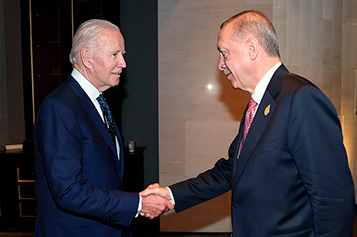 By Eugene KOGAN, Tbilisi-based defence and security expert By Eugene KOGAN, Tbilisi-based defence and security expert
Since the inauguration of President Biden in January 2021, the US administration has kept its relationship with Turkey to a bare minimum. For the Biden administration, the issue of human rights in Turkey remains very much on the agenda while for President Erdoğan, the issue seems to be a lower priority for his administration. Such behaviour infuriates not just Biden administration officials but also members of the House and the Senate. This has resulted in the Turkish president not being invited to Washington. Perhaps the two sides can each be blamed for their current relationship; however, Erdoğan is maintaining his course and appears unbothered by the consequences. For his part, Biden is keeping his cool despite a number of divergences in interests of the US and Turkey. READ MORE
- EGF Editor |
Published on EGF: 03.06.2023
| External Relations
-
|
|




